
The Ramat Gan Local Planning and Building Committee filed an indictment against a retired couple—longtime residents of the city—for constructing a retractable shade awning on the small balcony of their apartment.
The investigation and prosecution proceedings against the retired couple were conducted aggressively and in violation of human rights; they included a search warrant and the entry of four building inspectors who behaved aggressively toward the couple—see the ruling by Judge Noa Tabor:
"Another point worth considering is the manner in which the order authorizing entry onto the property was executed, in accordance with the instructions. Section 206(b)(4) toPlanning and Building Law 1965. An order to that effect was issued by the lower court, and the construction inspector had the authority to execute it. However, even when the court grants a request and issues an entry order, it must be executed in a proportionate manner that minimally infringes upon human rights; the Respondent would do well to ensure this is observed. The premises in question are the residence of the Appellants—two individuals aged approximately seventy. The municipal authorities are aware of the property's occupant. Even assuming the identity of the occupants had not been verified or known beforehand—and only became apparent after the Appellants opened the door—there was no justification for four inspectors to enter the apartment (p. 8, line 2 of the transcript dated April 7, 2025). Entry into a person's home represents a direct clash between the authority vested in the public body and an individual's right to privacy within the sanctity of their own home. The home is a person's sanctuary, and any entry into it must be handled with the caution and sensitivity demanded by the circumstances. When the suspected violation involves the enclosure of a balcony, and the occupants turn out to be two pensioners around the age of seventy, the conduct expected of the authority’s inspectors is not that described by the appellant. In her testimony before the lower court, she described the emotional distress she experienced when numerous inspectors entered her apartment—after being told she would go to jail if she did not open the door. The appellant described how she and her husband "simply shook" (p. 15, line 6 of the transcript from September 29, 2025), how they received no explanations, and how she wept and remained in a state of shock, unable to comprehend what was happening. This account describes conduct involving the use of force far greater than what the circumstances required; furthermore, the inspector’s responses in the lower court suggest that none of these factors were taken into consideration either at the scene or during the preparations for executing the order. These matters should have been considered. In the case at hand, it would have been preferable for a single inspector to enter the apartment and calmly explain the nature of the suspicion and the situation."
Furthermore, the Local Committee blatantly disregarded the fact that identical construction had been carried out in two other apartments in the building, and a claim of selective enforcement was raised—see the ruling by Judge Noa Tabor:
"I find it difficult to accept the position that an enforcement authority, upon arriving at a building to carry out an enforcement action, should turn a blind eye to visible construction—construction that clearly falls into the same enforcement category as the matter at hand and is plainly visible without requiring any further legal procedure. Even if the authority was originally summoned regarding a specific issue, it is not absolved of the duty to conduct proactive and even-handed enforcement when the circumstances on the ground warrant it. In my view, if enforcement action is being taken at a residence and there are reasonable grounds to suspect an additional, openly visible violation, the authority must examine the matter; it should not make the necessary inspection contingent upon the filing of a complaint. It is easy to envision a scenario where a neighborly dispute leads to a complaint regarding one specific issue but not another. Such instances occur frequently. When representatives of the authority arrive to investigate a complaint and are present at the building, it is inappropriate for the dispute alone to dictate the authority’s conduct or to serve as a blindfold regarding other evident facts. When the issue arises on-site—concerning the very type of suspected violation (namely, shading structures) within that same building, and especially in the case of a building that has undergone urban renewal (where occupancy dates for all apartments are known and no statute-of-limitations issue arises)—the authority is not required to wait for a further dispute or complaint before addressing what is plainly visible to it."
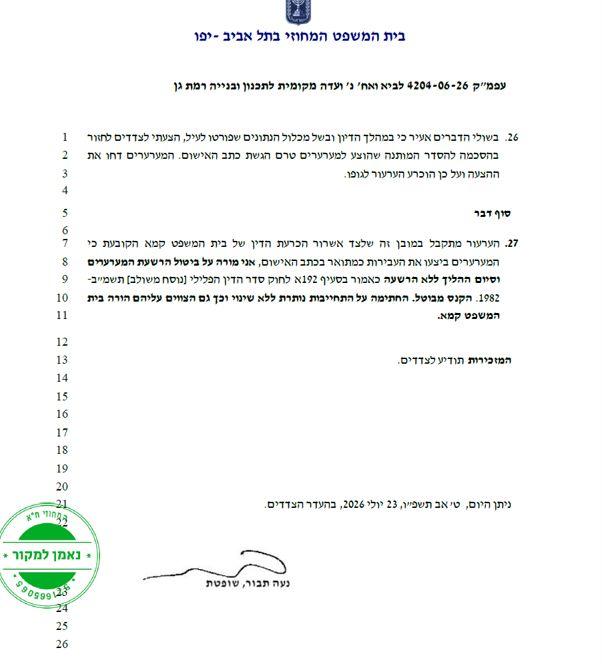
The court ruling sharply criticized the situation, determining that a "head-on clash" had occurred between the authority's power and an individual's right to privacy within the sanctity of their home. Furthermore, the court upheld the claim of selective enforcement against the couple.
The ruling set aside the conviction and the fine. Regarding the construction, the couple will be required to bring it into compliance with the exemption regulations in the coming months.
See the link to the article published on the Magdilim website – "מפקח הבנייה לא הרים את עיניו": בגלל אכיפה בררנית, בוטלה הרשעת הבנייה של בעלי דירה ברמת גן | מגדיל
The firm specializes in planning and construction and regularly represents residents in legal proceedings arising from building violations.
 English
 Hebrew